Tours to Israel » Туры » Tour “Israel — Crossroads of Religions”
The Holy Land is the center of the three monotheistic religions — Judaism, Christianity, and Islam — but it is also sacred to Bahá’ís around the world, since the tombs of Bahá’u’lláh and the Báb are located here.
The Druze, who emerged from Islam about a thousand years ago, revere here the tomb of one of their most important prophets, Jethro (Yitro), who was also the father-in-law of Moses, the leader and prophet of the Jewish people.
This land also became a refuge for the Circassians (Adyghe people) from the distant Caucasus.
Messengers from the Indian state of Punjab, followers of Ahmad Ghulam as a new prophet, also came here. Today, their descendants live in Haifa.
Haifa is likewise the birthplace of the Carmelite Order, founded here by the Crusaders in the 12th century.
The history of the Holy Land, despite its tiny size on the map, is too vast to fit even into the most monumental books. It is better to see it once with your own eyes.
The schedule and days of excursions depend on the arrival date.
Changes to the itinerary and excursion schedule may occur on national and religious Jewish and Christian holidays, as well as due to circumstances beyond the company’s control (such as weather conditions, etc.).
Arrival at Ben Gurion Airport. Transfer to Tel Aviv. Hotel check-in.
Evening walk through Tel Aviv–Jaffa.
Old Jaffa (Joppa) — where, according to legend, Noah built his Ark and Perseus rescued Andromeda. Walk through streets that remember Alexander the Great, Richard the Lionheart, and Napoleon. This was also the starting point of the pilgrimage route to Jerusalem.
Tel Aviv — the cultural and tourist center of Israel. From the first neighborhood of Neve Tzedek to modern skyscrapers, Tel Aviv today symbolizes youth, energy, ambition, and serves as the center of the country’s business, scientific, and cultural life. It is also known as the trendsetter of Israeli fashion and is often called the “City That Never Stops.”
Overnight stay in Tel Aviv.
Haifa — the world center of the Bahá’í Faith, famous for its cascading gardens descending from Mount Carmel to the Mediterranean coast, and for the Shrine of the Báb, founder of the Bahá’í religion.
Ahmadiyya Mosque — representing the reformist branch of Islam that promotes the concept of “spiritual jihad.”
Mount Carmel — the “Vineyard of God,” a unique place associated both with the worship of the god Helios in antiquity and with the Prophet Elijah, who defeated the priests of the pagan god Baal. The Cave of Elijah is revered by Muslims, Christians, and Jews alike. Visit to the Catholic monastery Stella Maris, the main monastery of the Carmelite Order.
Moshava Germanit — a district of Haifa with architecture unusual for Israel and a fascinating history, built in the mid-19th century by the Templers, a community of German Protestants.
Introduction to the traditions and lifestyle of the Druze, who separated from Islam in the 11th century and established a secret monotheistic religion. Visit to the Druze village of Usfiya. Tasting of traditional Druze cuisine (extra charge).
Nazareth — the city where Jesus lived. Visit to the Church of the Annunciation, built above the home of the Holy Family, and the Church of the Archangel Gabriel at Mary’s Spring. Transfer to the shores of the Sea of Galilee (Lake Kinneret).
Tiberias — one of the four holy cities of Judaism, historically an important Jewish spiritual and cultural center where many outstanding religious scholars lived.
Optional: relaxation at Hamei Tiberias — a complex of indoor and outdoor thermal mineral pools offering a wide range of wellness and cosmetic treatments.
Overnight stay in Tiberias.
Safed (Tzfat) — the city of mysticism and Kabbalists. The great thinkers of the 16th century in Safed and the foundations of Lurianic Kabbalah.
Rehaniya: the story of the Circassians in the Holy Land. Tasting of Caucasian cuisine with an Arab influence (extra charge).
Sea of Galilee (Lake Kinneret).
Capernaum — where Jesus healed the possessed man, raised the daughter of Jairus, and cured Peter’s mother-in-law. Visit to the Monastery of the Twelve Apostles.
Mount of Beatitudes (panoramic view) — the traditional site of the Sermon on the Mount.
Tabgha — the site of the miraculous multiplication of the loaves and fishes. It is also traditionally associated with Jesus walking on the waters of the Sea of Galilee.
Yardenit — a traditional baptismal site where pilgrims immerse themselves in the sacred waters of the Jordan River.
Overnight stay in Tiberias.
Transfer to Jerusalem through the Jordan Valley.
Visit to Beit She’an (Scythopolis) — the principal city of the Decapolis (the “Ten Cities” in the New Testament tradition), which led the alliance of Greco-Roman cities.
Jericho (viewed en route) — one of the oldest cities in the world, with the earliest settlements dating back to 9000 BC, and associated with the famous biblical expression “the walls of Jericho.”
Arrival in Jerusalem.
Hotel check-in. Rest.
Optional: “Night Mystery” — an evening light and music show in the Old City presenting the 3,000-year history of Jerusalem.
Overnight stay in Jerusalem.
Bethlehem. One of the oldest churches in the Holy Land — the Church of the Nativity, built on the site of the Savior’s birth: the Grotto of the Nativity, the cave of St. Jerome, and the miraculous icon of the Virgin Mary known as the “Bethlehem Mother of God.”
Old City of Jerusalem. Christian Quarter: the stations of the Via Dolorosa — the path Jesus Christ walked to the place of His Crucifixion. The Threshold of the Judgment Gate and the “Eye of the Needle” (Alexander Compound).
Church of the Holy Sepulchre. Veneration of the Holy Tomb. Golgotha. The Stone of Anointing. The site of the discovery of the True Cross.
Mount Zion: the Upper Room of the Last Supper, the Tomb of King David, and the Church of the Dormition of the Virgin Mary.
Armenian Quarter (panoramic tour): the Church of St. James and the Armenian Patriarchate.
Jewish Quarter: walk through the streets of the quarter, where modern residential buildings stand alongside remains from the periods of the First and Second Temples. The Cardo — the central street of Jerusalem during the Roman era. The Western Wall — the holiest site in Judaism, where visitors leave written prayers.
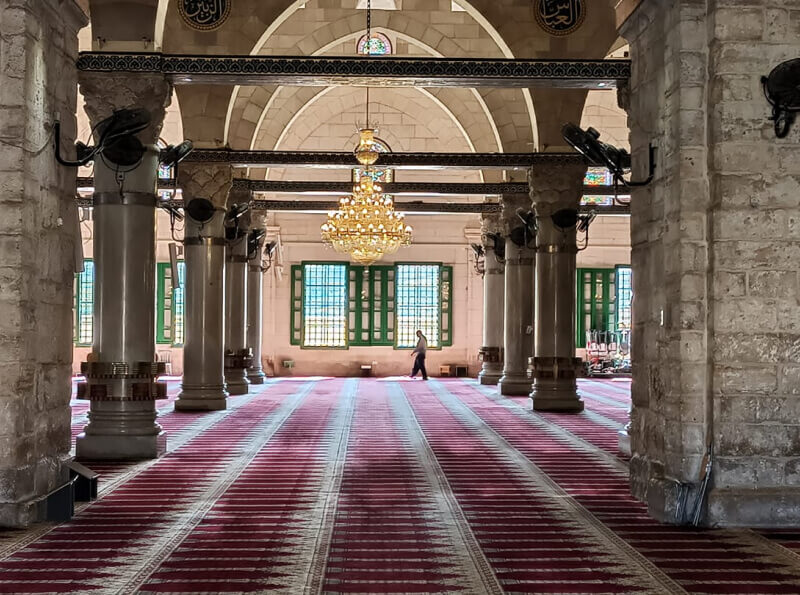
Muslim Quarter: panorama of the Dome of the Rock and the Al-Aqsa Mosque. Visit to the Arab market.
Overnight stay in Jerusalem.
Panorama of Jerusalem from the Mount of Olives — the traditional site of the Ascension of Jesus Christ, overlooking monasteries and churches on the Mount of Olives. Visit to the Russian Ascension Convent, the Russian Church of Mary Magdalene, the Franciscan church Dominus Flevit, where Christ wept over the future of Jerusalem, and the Carmelite monastery located on the site associated with the teaching of the Lord’s Prayer (“Our Father”).
Garden of Gethsemane. The Church of All Nations, built on the site of the Agony in the Garden. The cave church with the Tomb of the Virgin Mary. The miraculous icon of the Virgin Mary known as the “Jerusalem Mother of God.”
Ein Karem — a picturesque district of Jerusalem traditionally believed to be the birthplace of John the Baptist and the place where Elizabeth, the mother of John the Baptist, met the Virgin Mary. Visit to Mary’s Spring, as well as Orthodox and Catholic monasteries and churches.
Overnight stay in Jerusalem.
Introduction to the Judean Desert — from ancient monasteries to modern cities. The Judean Desert is considered the birthplace of Christianity. The unique natural health resort of the Dead Sea lies 420 meters below sea level.
Masada Fortress (with cable car ascent) — a symbol of Jewish heroism during the Roman conquest of Judea. Visit to a Bedouin settlement, camel riding, and tasting of traditional Bedouin cuisine.
Introduction to the unique properties of Dead Sea cosmetics. Consultants will assist in selecting cosmetic products. Relaxation and swimming in the Dead Sea.
Overnight stay in Jerusalem.
Transfer to the airport.