
Tours to Israel » Tours » Temple Mount
As described in the Torah (the Old Testament), Mount Moriah (the Temple Mount) is the המקום designated by God for the patriarch Abraham to offer his son Isaac as a sacrifice.
According to Jewish, Muslim, and Christian traditions, this site is also regarded as the place where the creation of the world began. It is believed that on the stone at the summit of the mountain, God created the first human, Adam. The same stone is where Abraham was to offer his only son Isaac.
Later, King Solomon, son and heir of King David, built the First Temple, after which Mount Moriah came to be known as the “Temple Mount.” The First Temple was destroyed in 586 BCE by the Babylonian king Nebuchadnezzar II. The Second Temple was rebuilt 70 years later (516 BCE) by those returning from the Babylonian exile.
The concept of the “Cornerstone” appears multiple times in the Torah:
“Therefore thus says the Lord God: Behold, I lay in Zion a stone, a tested stone, a precious cornerstone, a sure foundation; whoever believes shall not be in haste” (Isaiah 28:16).
According to Jewish tradition, this “Cornerstone” is known as the “Foundation Stone” (in Hebrew, Even ha-Shetiyah). It is a part of the bedrock of the Temple Mount upon which the Ark of the Covenant once stood, containing the stone tablets of the Ten Commandments. According to the Torah, these were given by God to the prophet Moses on Mount Sinai. The Ark symbolized the covenant between God and the people of Israel.
After the construction of the First Temple in Jerusalem, the Foundation Stone was placed in a special inner chamber known as the “Holy of Holies.”
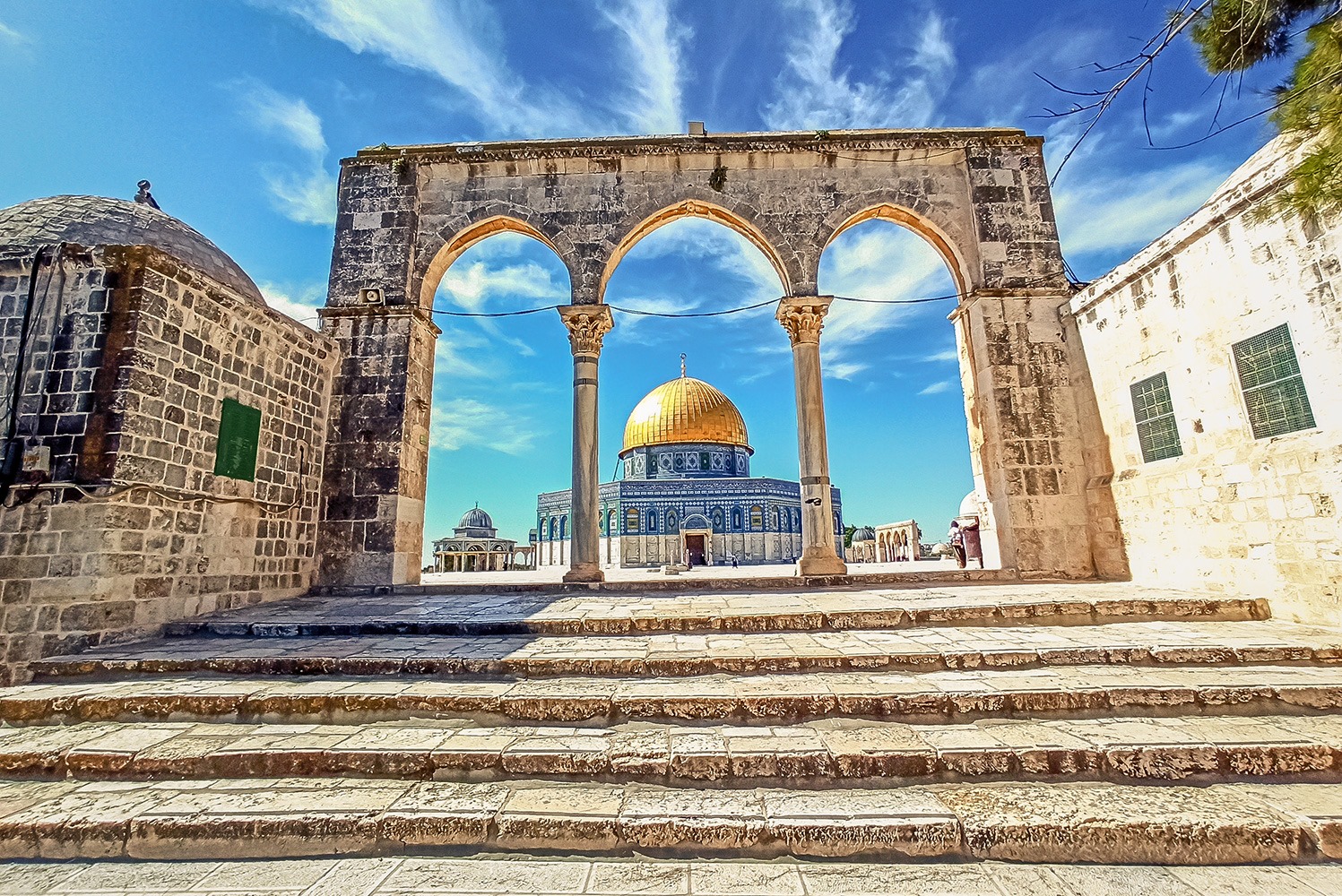
Muslims refer to the “Cornerstone” as the “Foundation Rock” (in Arabic, as-Sakhra), which is believed to be the rocky outcrop over which the Dome of the Rock (Qubbat as-Sakhra) was built. According to Islamic tradition, it was from this very spot that the Prophet Muhammad ascended to heaven during the Night Journey.
It is also believed that within the Dome of the Rock lies another revered site — the famous suspended stone known as Hajar al-Mu‘allaq (“the Hanging Stone”).
The Dome of the Rock was constructed in 691 CE by the Umayyad Caliph Abd al-Malik. The structure has never functioned as a mosque; its primary purpose was to emphasize the sanctity of the site and to protect the Foundation Rock from environmental damage.
For Muslims, the Temple Mount is the third holiest site after Mecca and Medina. The Dome of the Rock, often called the “Golden Dome,” has become a defining symbol of both the Temple Mount and Jerusalem.
The Temple Mount is venerated by Christian pilgrims as a place closely associated with the life of the Savior, Jesus Christ. During major religious festivals in the time of Jesus, all the inhabitants of Jerusalem, along with pilgrims from across the land, would gather here:
“Every year His parents went to Jerusalem for the Feast of the Passover” (Luke 2:41).
It was here, in the Temple, that the twelve-year-old Jesus engaged in discussion with the teachers (see Luke 2:46–49).
Christians regarded Jerusalem as the center of the world, calling it the “Navel of the Earth.” During the time of Helena, it was established that this symbolic center lay opposite the entrance to the Tomb of Christ. Since then, it has been venerated as the spiritual center of the Christian world and a place associated with the salvation of humankind.
The “Navel of the Earth” is marked by a stone vessel with a sphere inside it, engraved with a cross. It is located within the Church of the Holy Sepulchre, along the central axis connecting the altar of the cathedral of the Jerusalem Patriarchate and the Edicule, the chapel built over the Holy Tomb.
From the account of the 12th-century pilgrimage of Daniel the Abbot to the Holy Land:
“Here, beyond the wall and outside the altar, lies the Navel of the Earth; above it is a vault, and above that, in mosaic, Christ is depicted, with the inscription: ‘With the span of My hand I measured heaven and earth.’”