Tours to Israel » Туры » Tour for Muslim Pilgrims
Israel has long attracted Muslim pilgrims from many countries around the world, including Azerbaijan, Kazakhstan, Uzbekistan, Kyrgyzstan, Tajikistan, Turkey, the United Arab Emirates, Morocco, Albania, Bosnia and Herzegovina, and other countries whose citizens are permitted to visit Israel.
Acquaintance with the Islamic traditions of the Holy Land gives pilgrims an opportunity not only to connect with the rich religious and cultural heritage of Islam in the Middle East, but also to gain a deeper understanding of the unique relationship between the three Abrahamic religions in Israel and to form their own impression of the life, history, and diversity of our country.
The proposed pilgrimage programs include visits to the major Muslim holy sites of Israel. These tours may also be of great interest to history enthusiasts, researchers of Islam and Islamic architecture, ethnographers, and anyone interested in the cultural heritage of the region.
Customized itineraries can also be developed according to the specific wishes and interests of the group or individual travelers.
Group tours are organized throughout the year, except during major holiday periods.
Arrival at Ben Gurion Airport (Tel Aviv) and completion of all necessary border and entry procedures.
Meeting with a representative of the host company.
Transfer to Jerusalem and hotel check-in. Time for rest.
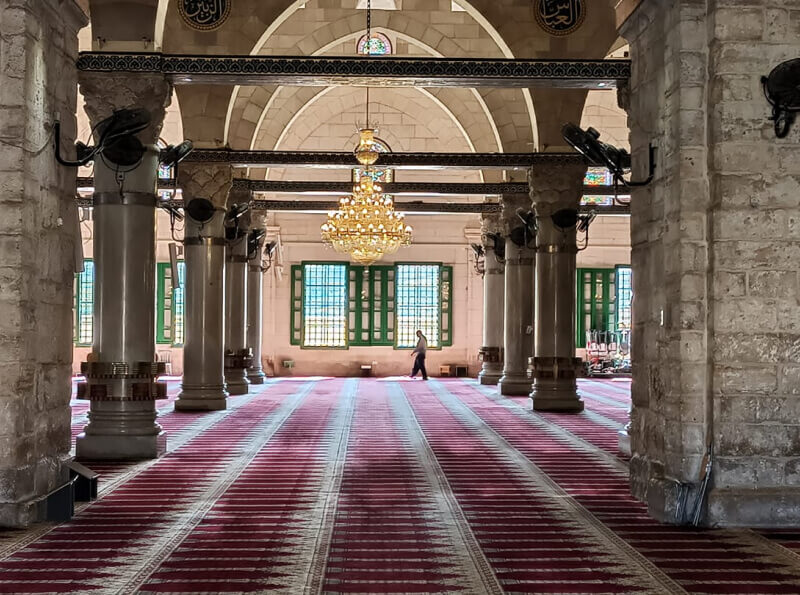
Prayer at Al-Aqsa Mosque.
Dinner and overnight stay at the hotel in Jerusalem.
Introduction to the sacred Islamic sites of the Temple Mount (Haram al-Sharif). Visit to the golden Dome of the Rock (Qubbat al-Sakhra), from where, according to Islamic tradition, the Prophet Muhammad ascended to the heavens and spoke with Allah.
Visit to Masjid al-Aqsa (“the Farthest Mosque”), to which the Prophet Muhammad was miraculously transported before his ascension to heaven (Mi‘raj) to the Throne of Allah. Visit to the Mosque of Caliph Umar ibn al-Khattab and the Muslim Quarter of the Old City.
Prayer at Al-Aqsa Mosque.
Dinner and overnight stay in Jerusalem.
Visit to the city of Al-Khalil (Hebron). Here are located the revered burial places of the Prophet Ibrahim and his wife Sarah, the Prophet Ishaq and his wife Rifqah, the Prophet Ya‘qub and his wife Leah.
Prayer at the Ibrahimi Mosque.
Combined performance of the Dhuhr and ‘Asr prayers.
Visit to traditional workshops producing famous Palestinian ceramics and glassware in Al-Khalil.
Visit to Bayt Lahm (Bethlehem) — associated in Islamic tradition with the birthplaces connected to the Prophets Isa (Jesus) and Dawud (David). Visit to the Mosque of Caliph Umar ibn al-Khattab, the oldest mosque in Bethlehem.
Prayer at Al-Aqsa Mosque.
Dinner and overnight stay in Jerusalem.
Visit to the city of Ramla, the former capital during the era of Caliph Harun al-Rashid, founded by the Umayyad Caliph Sulayman ibn Abd al-Malik, who made it his capital in 715 CE. Visit to the Great Mosque of Ramla and prayer there.
Visit to the “Mosque of the Forty”, built in memory of Muslim martyrs who died for their faith. Exploration of the underground Pool of Arches, reminiscent of the tales of One Thousand and One Nights. Visit to the traditional site associated with the Prophet Salih.
Walking tour through the ancient streets of Jaffa (Yafa) — the “Bride of the Sea,” an old Mediterranean port city. Visit to the Old City and the historic Hassan Bek Mosque.
Prayer at Al-Aqsa Mosque.
Dinner and overnight stay in Jerusalem.
Journey to the Dead Sea — known in Islamic tradition as Bahr al-Lut (the Sea of Prophet Lut). Along the way, visit to the shrine of Nabi Musa.
Excursion through the city of Ariha (Jericho), considered the oldest continuously inhabited city in the world, with a history dating back more than 10,000 years.
Visit to the ruins of the Umayyad Palace, built during the reign of Caliph Hisham ibn Abd al-Malik, and to the spring of Ein al-Sultan.
Swimming and relaxation in the healing waters of the Dead Sea.
Prayer at Al-Aqsa Mosque.
Dinner and overnight stay in Jerusalem.
Participation in the Friday Prayer (Jumu‘ah) at Al-Aqsa Mosque.
Collective prayer at Al-Aqsa Mosque.
Panoramic view of the Holy City of Al-Quds from the Mount of Olives (Jabal al-Zaytun) — traditionally associated with the ascension of the Prophet Isa (Jesus) — overlooking the sacred sanctuary of Haram al-Sharif.
Visit to the Mosque of Salman al-Farisi, located at the foot of the Mount of Olives, as well as the tomb traditionally associated with Rabia al-Adawiyya.
Visit to the cave connected in tradition with Bibi Maryam (Mary), the Garden of Gethsemane, associated with the events preceding the arrest of Prophet Isa, and the traditional birthplace of Bibi Maryam.
Visit to the burial cave of the Prophet Zakariya (Zechariah), the traditional tomb of the Prophet Dawud (David), the site associated with the final meal of Prophet Isa with his disciples, and the place connected with the Dormition of Bibi Maryam.
Prayer at Al-Aqsa Mosque.
Dinner and overnight stay in Jerusalem.
Visit to the city of Akko (Acre), an ancient Mediterranean port conquered by Salah al-Din al-Ayyubi (Saladin) from the Crusaders after his victory at the Battle of Hattin (Qarnei Hittin).
Walk through the Muslim Quarter. Visit to the historic Al-Jazzar Mosque, whose most revered relic is believed to be a hair of the Prophet Muhammad.
Prayer at Al-Aqsa Mosque.
Dinner and overnight stay in Jerusalem.
Transfer to the airport.