Tours to Israel » Travel to Israel » Armenian Quarter in Jerusalem
The first Armenian monks settled in Jerusalem even before Armenia adopted Christianity as a state religion in 301 CE under King Tiridates III. From the 4th century onward, Armenian churches began to be built, including the Monastery of St. James on Mount Zion, near the Cenacle. Around this monastery, the Armenian Quarter gradually took shape.
By the 6th century, a secular Armenian community had emerged, consisting of merchants and craftsmen. In the 12th century, the Monastery of St. James was expanded, and the Cathedral of St. James was constructed, becoming the spiritual center of the Armenian community in Jerusalem.
In the early 20th century, the quarter experienced rapid growth as refugees arrived, fleeing the Armenian Genocide in the Ottoman Empire.
Today, the Armenian community of Jerusalem is largely composed of people in creative professions—artists, photographers, silversmiths, and ceramic artisans.
The Armenian Quarter remains the most secluded and mysterious part of the Old City.
The Armenian Patriarchate of Jerusalem of the Armenian Apostolic Church is located in the heart of the Armenian Quarter of the Old City of Jerusalem. Although the exact date of the foundation of the Armenian Apostolic Church is unknown, it is one of the oldest churches in the Christian world to have attained patriarchal status.
The Armenian Kingdom was the first state to adopt Christianity as its official religion in 301 CE—25 years before the Byzantine Empire proclaimed Christianity under Emperor Constantine the Great. The earliest known records of the Armenian Patriarch of Jerusalem date from 638–669 CE.
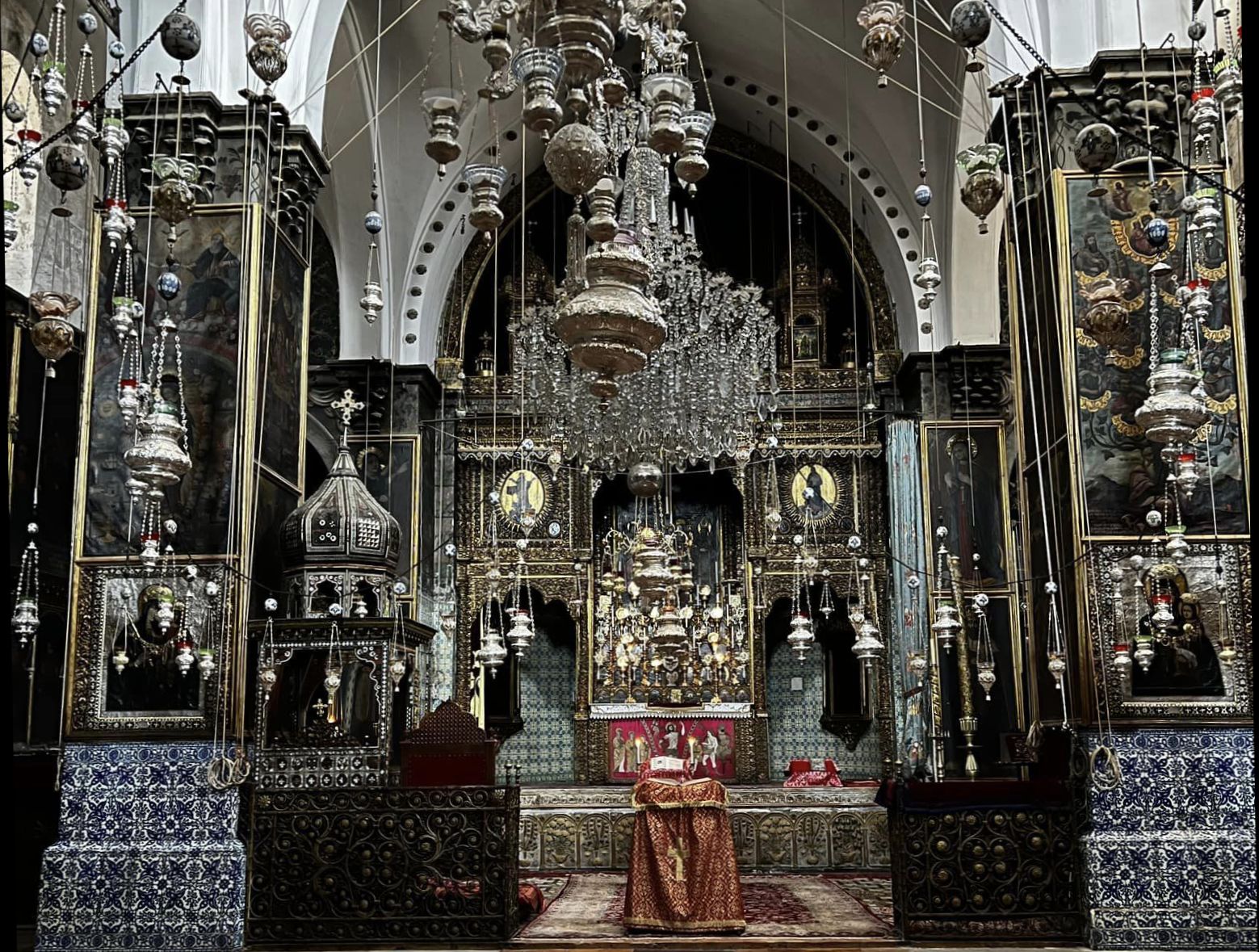
The Armenian Patriarchate includes the Monastery of St. James, which houses the Patriarch’s residence, as well as the Cathedral of St. James, named in honor of two Apostles of Jesus Christ—James the Greater and James the Less.
The quarter is also home to numerous historic buildings and institutions, including a theological seminary, a rich library containing ancient manuscripts (some dating back to the 13th century), a museum dedicated to Armenian history, culture, and art, as well as several churches and monasteries.
Particularly revered is the Monastery and Church of the Holy Archangels (“Srbotz Reshtakapetats”). According to tradition, this site stands on the location of the house of the High Priest Annas. After his arrest, Jesus was brought here and tied to a dead olive tree, which, according to legend, miraculously came back to life. During the interrogation in the courtyard, one of the servants struck the Savior, and the angels covered their eyes with their wings in shame—reflected in the name of the monastery. The olive tree is believed to possess miraculous properties, and many accounts speak of healing, including from infertility, after touching it or tasting its fruit.
The Armenian Church holds chapels and altars in major Christian holy sites, including the Church of the Holy Sepulchre, the Church of the Dormition of the Virgin Mary, and the Church of the Nativity in Bethlehem, as well as several monasteries and churches throughout Israel.
According to Armenian tradition, every believer should make a pilgrimage to the Holy Land at least once in their lifetime. In remembrance of this journey, pilgrims were granted the title “mahtesi”—literally “one who has seen death,” symbolically referring to a person who has endured and overcome great hardships on the way to the Holy Sepulchre.
We invite you to visit the Holy Land and experience its Christian heritage. The itinerary may include visits to such sacred sites as the Cathedral of St. James in the Armenian Quarter of the Old City of Jerusalem, the Church of St. Peter in Gallicantu (House of Caiaphas), the Church of the Holy Archangels (House of Annas), the Church of the Holy Sepulchre, the Garden of Gethsemane, the Tomb of the Virgin Mary, the Church of the Nativity in Bethlehem, Armenian monasteries, and many other significant sites.

The Cathedral of St. James is the symbol of Armenian Jerusalem and the Armenian Quarter. It is named in honor of two Apostles of Jesus Christ—James the Greater and James the Less.
James the Greater was one of the twelve apostles, among the closest disciples of Christ, and the brother of the Evangelist John. He is often referred to as James, the son of Zebedee. The cathedral is also dedicated to James the Less, called in the Gospels the “brother of the Lord,” as he is believed to have been the son of Joseph and the stepbrother of Jesus. James became the head of the first Christian community and the first Bishop of Jerusalem; he was executed in 44 CE by King Herod Agrippa I.
Originally, a small Byzantine church stood on this site. In the 12th century, the Crusaders built a church here dedicated to St. James. The present-day complex includes structures dating from the 12th to the 18th centuries.
Within the cathedral, in the Chapel of St. James the Greater, the head of the apostle is said to be buried at the site of his martyrdom. According to Christian tradition, James the Less was originally buried in a cave in the Kidron Valley; his remains were later transferred to the cathedral, where they now rest beneath the main altar.
The cathedral also venerates the tomb of Bishop Macarius of Jerusalem (314–333), who is believed to have indicated to St. Helena the location of the burial site of Jesus.
In Spain, a tradition emerged in the 7th century linking James the Greater with missionary work. In the 9th century, his relics were discovered and enshrined in Santiago de Compostela, which became the final destination of the famous pilgrimage route known as the Way of St. James—still widely popular today. In Spanish tradition, he is known as Santiago and is often depicted as a pilgrim with a staff and a scallop shell—symbols of the pilgrimage to Santiago de Compostela.
Jerusalem Tours >